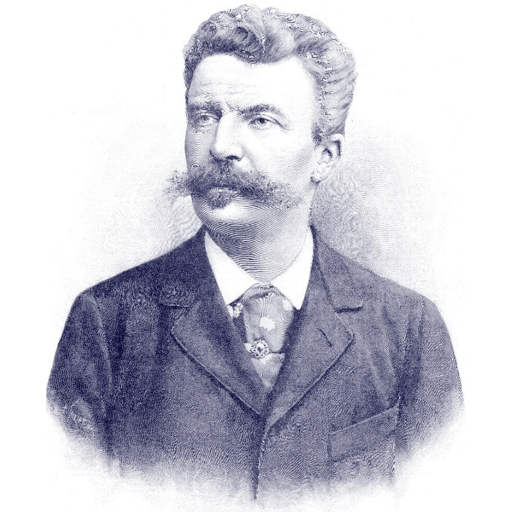
Maupassant's Paris: A Journey Through the Places That Shaped His Life
Categories : Parisian life, published on : 12/26/24
IN THE FOOTSTEPS OF
Guy de Maupassant in Paris
- Guy de Maupassant lived and wrote in Paris from 1876 until his death
- Key locations include Café de la Paix, Opéra Garnier district, and Jardin des Tuileries
- His apartment on Rue de Montpensier (1st arrondissement) inspired much of his work
- Famous novel "Bel-Ami" offers sharp critique of Parisian society
- Maupassant frequented both aristocratic salons and popular neighborhoods
- Literary walking tour covers 6th, 1st, and 9th arrondissements
WHO WAS
Guy de Maupassant?
Guy de Maupassant (1850-1893) was an influential French writer who mastered the short story and Realist/Naturalist novels. Protégé of Gustave Flaubert, he wrote around 300 short stories and six novels including "Boule de Suif," "Bel-Ami," and "The Necklace." His work focused on everyday French life, particularly during the Franco-Prussian War, with a cynical yet clear-eyed view of human nature. He produced this prolific output in just one decade (1880-1890). Tragically, syphilis contracted in his twenties led to severe mental illness. He died in an asylum at age 42, leaving a lasting legacy as master of short fiction celebrated for sharp observations and narrative skill.
WHAT CAN YOU DISCOVER
Through Maupassant's Paris?
In this journey, we invite you to enter Maupassant's Paris through his favorite addresses, his residences, and places he frequented daily. A literary walk where each alley, each café, each park reveals more of the writer's soul.
His dual perspective on the city—worldly and popular—allows better understanding of Paris's complexity. Maupassant, while being the author of luxury, never ignored human miseries.
HOW DID GUY DE MAUPASSANT'S
Life in Paris Begin?
Where Was Maupassant Born?
Guy de Maupassant was born in 1850 in Fécamp, Normandy. However, it's in Paris that the writer's destiny was forged. After studying at Lycée Louis-le-Grand and law school, he found himself in Parisian literary circles.
There he met influential writers like Gustave Flaubert, who would become his mentor. Paris, city in perpetual effervescence, then became the crucible in which Maupassant would shape his first works.
What Role Did Maupassant’s Family Play?
His father, rarely present, and his mother, who possessed great influence over him, led him to settle in Parisian apartments. These spaces, at that time, represented far more than simple dwellings. They were spaces conducive to literary creation.
His mother's strong influence shaped his observational skills and sensitivity to human relationships. These qualities would later define his literary style.
When Did Maupassant Enter Literary Circles?
From 1876, Maupassant regularly attended Café de la Paix, an emblematic place of Parisian culture. Here he met important figures of his era's literature and art.
It's in this setting that his work took form, nourished by animated discussions, intellectual debates, and the capital's effervescent life. The café's intimacy became ideal terrain for the writer seeking new sensations.
What Café de la Paix offered:
- Meeting place for writers and artists
- Animated intellectual debates
- Observatory of Parisian society
- Social mixing between classes
- Daily source of literary inspiration
WHICH PLACES MARKED
Guy de Maupassant's Youth and Literary Beginnings?
Why Was Café de la Paix Important?
The early Parisian years of Maupassant were marked by assiduous attendance of several establishments that would nourish his work. One of the most emblematic was Café de la Paix, located at Place de l'Opéra Garnier.
This café, where Parisian bourgeoisie loved to gather, was an essential passage place for all writers, poets, and artists. Maupassant rubbed shoulders not only with Flaubert but also with figures like Zola and Guy de Clémenceau.
Who Maupassant met at Café de la Paix:
- Gustave Flaubert (his mentor)
- Émile Zola (fellow writer)
- Guy de Clémenceau (politician and journalist)
- Various artists and intellectuals
- Publishers and editors
It's in this place that the writer observed Parisian life, forging a sharp understanding of human behaviors, social relationships, and city contradictions.
Café de la Paix today:
- Location: Place de l'Opéra, 9th arrondissement
- Still operational: Yes, as luxury café-restaurant
- Visit: Open daily for meals and drinks
- Historical significance: Preserved 19th-century décor
Where Did Maupassant Live During His Early Years?
At that time, he resided in the 6th arrondissement, near the Latin Quarter, where he absorbed student life, narrow little streets, and cafés forming the backdrop of his first works.
It's also in these neighborhoods that Maupassant, under Flaubert's influence, entered literary circles and met editors, journalists, and other writers.
Latin Quarter influence on his work:
- Student bohemian atmosphere
- Intellectual café culture
- Proximity to publishers
- Young artist community
- Accessible yet vibrant neighborhood
What was Café de la Nouvelle-Athènes?
The Café de la Nouvelle-Athènes, at 9 Rue de la Trinité, was another of his haunts. Here, writers of Maupassant's generation regularly gathered to discuss literature, politics, and philosophy.
This café, located in Pigalle district, attracted impressionist painters and naturalist writers. The artistic ferment of this establishment directly influenced Maupassant's realistic writing style.
Café de la Nouvelle-Athènes details:
- Location: 9 Rue de la Trinité, 9th arrondissement
- Historical period: 1870s-1880s literary hub
- Famous patrons: Degas, Manet, Renoir, Zola
- Today: Building still stands, café no longer operates
WHERE DID GUY DE MAUPASSANT
Live in Paris?
What Was Special About the Rue de Montpensier Apartment?
The writer occupied several Paris apartments throughout his life, but the one he rented on Rue de Montpensier, in the 1st arrondissement near the Opéra, marked his Parisian experience.
This apartment was a true haven of peace in the capital's heart, a place where he could retreat and write. Steps from Opéra Garnier, a monument embodying both luxury and theater, this apartment became the perfect refuge for solitary writers.
Apartment characteristics:
- Located near Palais Royal gardens
- Quiet street despite central location
- View of elegant Parisian architecture
- Walking distance to major cultural sites
- Ideal writer's retreat atmosphere
The walls of this place witnessed the birth of several of his works, including his most famous novel, "Bel-Ami", which offers a sharp critique of Parisian society.
How Did the Opéra District Influence His Writing?
The Opéra neighborhood, both cosmopolitan and bourgeois, influenced Maupassant's writing. Strolling through its streets, he could closely observe the city's different faces: aristocracy, artists, and more modest people.
A bit farther, Boulevard Haussmann, with its grand department stores and luxury hotels, served as backdrop for many passages in his stories.
Opéra district characteristics:
- Mixed social classes
- Luxury commerce and entertainment
- Grand Haussmann architecture
- Theater and cultural institutions
- Perfect observation point for social dynamics
Maupassant was not only a high society writer but also an attentive observer of mechanisms governing social relationships in Paris.
Current visit details:
- Rue de Montpensier: Still exists near Palais Royal
- Neighborhood: Remarkably preserved 19th-century character
- Walking tour: Easily combined with other Maupassant sites
- Nearby: Comédie-Française, Louvre, Tuileries
WHERE DID MAUPASSANT
Take His Literary Walks?
Why Did He Love Jardin des Tuileries?
Maupassant loved strolling in Parisian parks, these havens of greenery where he could observe society without being part of it. The Jardin des Tuileries, located near his apartment, was a key place for his daily walks.
This garden, in the city's heart, symbolizes the transition between royal history and Parisian modernity. Along the Seine, with its statue-lined paths, the garden is a true haven of tranquility.
What Maupassant observed in Tuileries:
- Promenaders from various social classes
- Family interactions and dynamics
- Lovers meeting discreetly
- Children playing under nannies' watch
- Seasonal changes in garden atmosphere
It's in this environment that he wrote a large part of his short stories, observing walkers, families, and gathering story fragments he would use later in his narratives.
Tuileries Garden visit today:
- Location: Between Louvre and Place de la Concorde
- Access: Free, open daily
- Best for: Literary walks, people-watching
- Maupassant's favorite spots: Benches near central fountain
- Atmosphere: Still maintains 19th-century character
What drew Him to Bois de Boulogne?
It's also the Bois de Boulogne, located west of Paris, that sparked the writer's inspiration. This park, first conceived as a royal garden, became a meeting place for Parisians of all social classes.
Maupassant, always seeking picturesque scenes and characters with intriguing lives, often walked there, gathering anecdotes and atmospheres.
Bois de Boulogne's appeal:
- Vast natural space within Paris
- Social class mixing
- Hidden paths and lakes
- Romantic and mysterious atmosphere
- Escape from city center
These nourished the tension between beauty and human decadence, central theme of his work. The Bois, though farther from the city center, represents a Paris off beaten paths, more intimate, far from noisy cafés and literary salons.
Visiting Bois de Boulogne today:
- Distance from center: 20-30 minutes by metro
- Size: 845 hectares of parkland
- Activities: Walking, boating, cycling
- Maupassant sites: Lac Inférieur, wooded paths
- Best time: Spring and autumn for pleasant walks
WHICH DINING ESTABLISHMENTS
Did Maupassant Frequent?
What was Café de la Régence?
Guy de Maupassant, beyond his literary activities, appreciated gathering in Parisian establishments where one could savor refined cuisine and discuss philosophy and literature.
One of his favorite places was Café de la Régence, located on Rue de la Vieille-Draperie near Palais Royal. This essential meeting place for worldly Parisians of the era was exchange center for writers, artists, and journalists.
What Café de la Régence offered:
- Refined French cuisine
- Pot-au-feu (traditional beef stew)
- Tartares and veal escalopes
- Literary discussion atmosphere
- Elite social gathering space
Maupassant often went there for lunch or dinner, savoring typically French dishes.
Historical note:
- Location: Near Palais Royal (building preserved)
- Historical significance: Famous for chess players and writers
- Era: 1760s-1910s as literary café
- Today: No longer operates as café
Why Did He Visit Café Riche?
Another address dear to Maupassant was Café Riche, on Place de la Madeleine, sophisticated place where he could converse with his contemporaries, particularly press members and intellectuals of his time.
Here, discussions ran high, sometimes serious, sometimes lighter, but always animated by common love of literature, politics, and art.
Café Riche characteristics:
- Located in fashionable district
- Frequented by journalists and intellectuals
- Scene of political discussions
- Elegant Second Empire décor
- Meeting point for literary elite
How Often Did He Return to Café de la Paix?
Finally, Maupassant never missed going to Café de la Paix, Place de l'Opéra, a place the writer regularly frequented to soak up Parisian atmosphere.
The café, where elegant bourgeois and artists from all horizons crossed paths, was perfect place to observe society while enjoying pastries or simple but refined dishes.
Why Café de la Paix remained important:
- Central location at Opéra
- Cross-section of Parisian society
- Quality food and service
- Ideal people-watching venue
- Regular literary gatherings
WHAT ENTERTAINMENT VENUES
Did Maupassant Enjoy?
Did He Visit Moulin Rouge?
Beyond his favorite restaurants, Maupassant also enjoyed the capital's nocturnal pleasures. Le Moulin Rouge, on Boulevard de Clichy, was a place frequented by artists and writers seeking entertainment and distractions.
It was a par excellence place to see and be seen, where one could celebrate life and freedom, two themes resonating strongly in Maupassant's works.
Moulin Rouge in Maupassant's time:
- Opened 1889 (late in his career)
- Birthplace of French cancan
- Bohemian artist atmosphere
- Symbol of Belle Époque Paris
- Entertainment and social freedom
Visiting Moulin Rouge today:
- Location: 82 Boulevard de Clichy, 18th arrondissement
- Still operational: Yes, as cabaret venue
- Shows: Evening performances with dinner
- Historical character: Preserved Belle Époque façade
- Maupassant connection: Represents his era's entertainment culture
What Was Café Concert de la Gaîté?
He also went to Café Concert de la Gaîté, where one could hear popular songs and appreciate dance shows, a world allowing him to escape literary preoccupations and enjoy Parisian entertainments.
These variety venues represented the popular culture side of Paris that fascinated Maupassant. The contrast between high society salons and working-class entertainment venues informed his nuanced portrayal of Parisian life.
Did He Attend Literary Salons?
Worldly evenings were also meeting places for Maupassant, where he could build relationships with other writers and artists while having fun.
Private literary salons, often organized by patrons or influential friends, hosted inflamed discussions about culture, politics, and literature. These gatherings were opportunities for Maupassant to measure himself against peers while cultivating art of conversation and pleasure.
Literary salon culture:
- Hosted by wealthy patrons
- Invitation-only gatherings
- Intellectual conversation expected
- Social advancement opportunities
- Networking with publishers and critics
HOW DID PARIS INFLUENCE
Maupassant's Work?
How Does Paris Appear in His Writings?
In his novels and short stories, Maupassant often evokes Paris as a character in its own right. He paints the city under both majestic and brutal light, reflection of its multiple facets.
From dark alleys to animated boulevards, Paris becomes a place where joys and dramas of human life coexist.
Paris in Maupassant's major works:
- "Bel-Ami": Social climbing and corruption
- "Une Vie": Contrast between provincial and Parisian life
- Short stories: Various Paris neighborhoods and classes
- Social commentary: Critique of wealth and poverty
- Realist portrayal: Unflinching view of urban reality
His stories such as "Bel-Ami" or "Une Vie" are steeped in Parisian reality, often raw but always poignant, raising questions about human nature and society of the era.
What Were the Two Faces of Paris in His Work?
Maupassant, though evolving in literary and aristocratic milieu, didn't content himself with observing Paris from refined salons. He also went to popular neighborhoods, exploring the capital's contrasts.
His narratives often describe daily life scenes in animated cafés or popular places such as the Latin Quarter.
Dual Paris in Maupassant's writing:
- Worldly Paris: Opéra district, luxury cafés, aristocratic salons
- Popular Paris: Latin Quarter, working-class cafés, street life
- Social observation: Both faces equally important
- Literary technique: Contrast creates dramatic tension
- Human condition: Universal themes across social classes
Where one sees family in its diversity, sometimes difficult, sometimes warm, interactions between rich and poor form human spectacle, finding a powerful echo in his work.
This double look at the city allows better understanding of Maupassant's Paris complexity, who, while being the author of luxury, doesn't ignore human miseries.
FAQ:
Maupassant's Paris Literary Tour
Where should I start a Maupassant literary walking tour?
Answer: Start at Café de la Paix (Place de l'Opéra) where Maupassant met Flaubert and literary contemporaries. From there, walk to Rue de Montpensier (his apartment location), then to Jardin des Tuileries. End at Latin Quarter's literary cafés. The complete tour covers 3-4 hours walking at leisurely pace.
Are any of Maupassant's apartments open to visitors?
Answer: No, Maupassant's former residences are private buildings. However, you can view exteriors and explore surrounding neighborhoods that inspired his writing. Rue de Montpensier near Palais Royal preserves much of its 19th-century character.
Which cafés from Maupassant's time still exist?
Answer: Café de la Paix (Place de l'Opéra) remains operational as a luxury café-restaurant with preserved Belle Époque décor. Most other cafés Maupassant frequented have closed, but buildings often remain. Modern cafés in the Latin Quarter and Saint-Germain-des-Prés maintain a similar literary atmosphere.
What's the best time to visit Maupassant's Paris locations?
Answer: Visit weekday mornings (9-11 AM) for quietest Jardin des Tuileries and Palais Royal gardens. Café de la Paix works well for afternoon coffee (3-5 PM). Avoid tourist peak hours at major sites. Spring and autumn offer pleasant walking weather without summer crowds.
Can I visit Opéra Garnier as part of the Maupassant tour?
Answer: Yes, Opéra Garnier offers daily tours of the building. The opera house, completed in 1875, represents the Belle Époque elegance that pervades Maupassant's Paris. Purchase tickets online to skip queues. Allow 1-2 hours for a comprehensive visit including a grand staircase and auditorium.
Which Maupassant works should I read before visiting?
Answer: Read "Bel-Ami" for a vivid Parisian society portrayal. Short story collections like "Boule de Suif and Selected Stories" provide glimpses of various Paris neighborhoods. "Pierre et Jean" offers a family dynamics context. Reading even selections enhances appreciation of the locations you'll visit.
Is the Maupassant tour suitable for non-French speakers?
Answer: Yes, most locations are self-explanatory architectural sites. Café de la Paix has English-speaking staff. Consider downloading walking tour apps or audioguides about Belle Époque Paris. Many plaques at historic buildings include English translations. The visual experience transcends language barriers.
WHERE TO STAY DURING
Your Maupassant Literary Journey
After exploring Guy de Maupassant's Paris through literary landmarks, cafés, and gardens that shaped his masterpieces, you need accommodation perfectly positioned in the heart of this literary universe.
Hotel Bel Ami, located in the 6th arrondissement, invites guests to immerse themselves in the spirit of this era. Steps from numerous places frequented by Maupassant, this 5-star hotel was once the printing house of the literary work "Bel-Ami."
The hotel embodies elegance and the French art of living. Hotel Bel Ami becomes an ideal starting point for anyone wishing to traverse Maupassant's Paris, between past and present, while enjoying the luxury and charm of an exceptional establishment.
Why Hotel Bel Ami connects to Maupassant:
- Located in the 6th arrondissement where he lived
- Named after his most famous novel
- Former printing house of literary works
- Walking distance to Latin Quarter literary cafés
- Near Saint-Germain-des-Prés literary heart
The hotel sits at the crossroads of Maupassant's most significant Parisian locations. You can walk to the Latin Quarter in 5 minutes, reach Jardin des Tuileries in 15 minutes, and access Opéra district in 20 minutes by metro.
Literary neighborhood advantages:
- Surrounded by historic bookshops
- Classic Parisian café culture
- Saint-Germain-des-Prés literary heritage
- Proximity to Seine riverside walks
- Authentic Left Bank atmosphere
The 6th arrondissement preserves the intellectual and artistic atmosphere that defined Maupassant's Paris. The same narrow streets, historic buildings, and café terraces that inspired the writer remain largely unchanged.
Hotel Bel Ami's refined décor and contemporary comfort create a perfect balance between Belle Époque elegance and modern luxury. After days of exploring Maupassant's haunts - from the Café de la Paix to the Bois de Boulogne, from the Opéra district's salons to the Latin Quarter's bohemian cafés—you'll return to an accommodation embodying the same literary sophistication and Parisian charm that defined the writer's world.
Note: Many buildings from Maupassant's era remain, but interiors have changed. Café de la Paix preserves the most authentic atmosphere of the 19th century. Verify current opening hours for all locations. Some literary cafés mentioned no longer operate. The literary atmosphere of the 6th arrondissement and the Latin Quarter best preserves Maupassant's Paris spirit. Consider guided literary tours for a deeper historical context.