PARIS AND CINEMA: A WALK THROUGH THE LEGENDARY LOCATIONS OF THE GREATEST FILMS
Categories : Parisian life, published on : 5/15/26
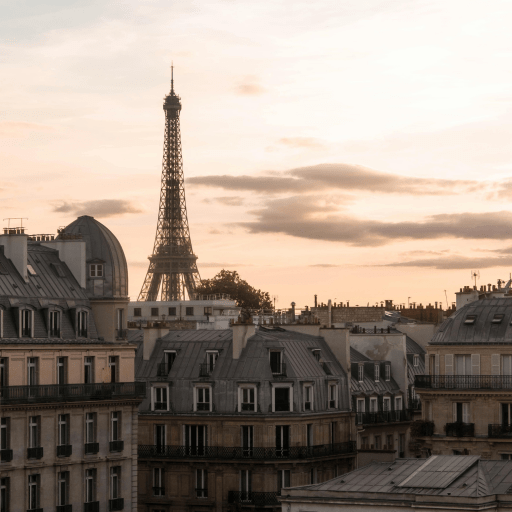
In Paris, some mornings already seem lit for the big screen. A terrace awakening in Saint Germain des Prés, a golden bridge beneath the rain, the steps of a church where one almost hears the 1920s returning… Since the beginnings of cinema, the capital has inspired French and international directors alike, from François Truffaut to Woody Allen, from Agnès Varda to Christopher Nolan. Paris has never merely been a backdrop. It is a character, a muse, a promise.
From Hôtel Bel Ami, at 7 rue Saint Benoît, this cinematic walk begins almost naturally. Just steps from the hotel, literary cafés, mysterious churches and the banks of the Seine create an ideal itinerary for rediscovering Paris through cinema’s most memorable scenes. Here is our selection of legendary locations where you can walk in the footsteps of the greatest films shot in Paris.
SAINT GERMAIN DES PRÉS
a setting of elegance and cinema
It is hard to imagine a more beautiful opening sequence. Just two minutes from Hôtel Bel Ami, Saint Germain des Prés offers the cinematic Paris we love to see on screen: historic façades, bookshops, hurried silhouettes, conversations on café terraces. In Intouchables, released in 2011 with Omar Sy and François Cluzet, the neighbourhood appears through one of its most emblematic addresses: Les Deux Magots, on place Saint Germain des Prés. The film by Éric Toledano and Olivier Nakache helped bring this elegant, vibrant Paris back into the contemporary imagination.
Come in the morning for a coffee, in the afternoon to watch the choreography of the boulevard, or in the early evening when the lights reflect in the shop windows. Café de Flore, Brasserie Lipp, the nearby galleries and rue Saint Benoît or rue Jacob all extend this unmistakably Left Bank atmosphere. Long before modern cinema, Saint Germain was already a natural setting for writers, artists and screenwriters: an open stage, where every terrace seems to be waiting for its dialogue.
Good to know: set off on foot from Hôtel Bel Ami. The charm of the neighbourhood reveals itself in its detours, between a discreet bookshop, an old window display and a table where one lingers longer than expected.
SAINT SULPICE
mystery and spectacle
Less than ten minutes away on foot, the Church of Saint Sulpice shifts the atmosphere entirely. Here, elegant Paris becomes more secretive. In The Da Vinci Code, released in 2006 and directed by Ron Howard, the location contributes to the film’s esoteric mood, carried by Tom Hanks, Audrey Tautou and Ian McKellen. Even if certain fictional liberties have fed the legend, Saint Sulpice retains a rare power: that of turning a visit into an enigma.
Even without knowing the film by heart, the experience is striking. The vast, peaceful square invites you to pause before entering. Inside, the eye wanders through the volumes, chapels and details. The light, often soft, heightens this feeling of a monumental, silent set, as though the scene might begin at any moment.
Insider tip: come in the late morning, when the light gently crosses the nave, then continue towards the Luxembourg Garden. It is one of the most beautiful walking sequences from Saint Germain des Prés.
THE LOUVRE AND THE PALAIS-ROYAL
Paris in all its majesty
Change of scene: head towards the Louvre, one of the most spectacular settings in international cinema. In The Da Vinci Code, the pyramid designed by Ieoh Ming Pei plays a central role, transforming the museum into a theatre of suspense and revelation. The place has fascinated other filmmakers too: Jean Luc Godard filmed the legendary race through the Louvre in Band of Outsiders in 1964, as his characters rush through the museum galleries in a scene that has become iconic.
From Saint Germain des Prés, the Louvre can be reached on foot by crossing the Seine. It is one of the capital’s most beautiful routes: Pont des Arts, the quays, Cour Carrée, the pyramid. A few minutes away, the Palais Royal offers a more intimate interlude, with its Buren columns, galleries and almost hidden garden. Its highly graphic elegance regularly attracts photographers, directors and fashion teams.
Good to know: for a truly cinematic atmosphere, choose nightfall. The glass of the pyramid, the arcades and the cobblestones then take on an almost unreal dimension.

LE PONT ALEXANDRE III
romance beneath the lights
Some places need no artifice. Pont Alexandre III, with its gilding, nymphs and perspective over Les Invalides, seems to have been designed for wide shots. In Midnight in Paris, released in 2011, Woody Allen makes it one of the most romantic symbols of the capital, particularly during the final scene in the rain. Owen Wilson, Marion Cotillard, Rachel McAdams and Léa Seydoux move through a dreamed Paris, nostalgic and deliciously cinephile.
Come here to walk slowly, gaze at the Seine, glimpse the Eiffel Tower in the distance and understand why so many filmmakers love filming Paris from its bridges. The location is also wonderful at night, when the streetlamps cast a soft, almost theatrical light. The city then seems suspended, somewhere between postcard and cinema scene.
Among our favourite addresses around the bridge: continue your walk towards the quays of the Grand Palais and Les Invalides, then reserve a table at Café de l’Esplanade, a chic and very Parisian address in the 7th arrondissement, facing Les Invalides. We love its elegant atmosphere, soft banquettes, terrace on sunny days and refined brasserie cuisine, perfect for extending the magic of Pont Alexandre III over a Left Bank dinner.
LE PONT DE BIR-HAKEIM
vertigo and architecture
With its metal columns, repeating lines and view of the Eiffel Tower, Pont de Bir Hakeim offers a more graphic, almost futuristic Paris. Christopher Nolan filmed a striking scene there for Inception, released in 2010, with Leonardo DiCaprio, Elliot Page, Marion Cotillard and Joseph Gordon Levitt. In the film, Paris becomes a mental space, able to fold, rebuild itself and tip into dream.
This location attracts both cinema lovers and photography enthusiasts. The central walkway, covered by the structure of the elevated metro, creates a spectacular perspective. It is a more contemporary, more kinetic Paris, best discovered early in the morning to avoid the crowds and enjoy the light over the Seine.
Good to know: after Pont de Bir Hakeim, two atmospheres await. On the Trocadéro side, the walk takes on a more Haussmannian tone, between beautiful façades, elegant avenues, small neighbourhood cafés and spectacular views of the Eiffel Tower. On the Île aux Cygnes side, the setting becomes more graphic and almost industrial: moored barges, containers, large contemporary buildings and the silhouettes of the Beaugrenelle towers, with the shopping centre nearby for a shopping or coffee break.
MONTMARTRE
In the footsteps of Amélie Poulain
To conclude this walk, head north. Montmartre remains one of the great emotional settings of French cinema, carried into the collective imagination by Amélie, released in 2001. Directed by Jean Pierre Jeunet, with Audrey Tautou and Mathieu Kassovitz, the film revealed to the world a poetic, colourful and slightly unreal Montmartre. Café des Deux Moulins on rue Lepic, Amélie’s apartment on rue des Trois Frères and Studio 28 together create a tender and instantly recognisable itinerary.
Here, Paris becomes a village. The staircases, façades, signs and narrow streets all seem to invite you to slow down. One quickly understands why Jean Pierre Jeunet chose this neighbourhood: Montmartre has a light, a fantasy and a relief that the camera loves. It is an ideal walk in the late afternoon, when the light slips over the slopes of the hill and the terraces begin to come alive.
From Hôtel Bel Ami, Montmartre is easy to reach by taxi or metro, before returning to the refined calm of Saint Germain des Prés. Like stepping back behind the scenes after a day spent among the most legendary settings in Paris.
Because visiting Paris through cinema is more than a themed walk. It is a way of looking at the city differently, with the eye of a director, the curiosity of a traveller and the rare pleasure of recognising, at the corner of a street, a scene one thought belonged only to the movies.